Why Did My Credit Score Drop? Common Reasons
It can be incredibly disheartening, even a little bit scary, to log in, check your credit score, and see that number has dropped. You're left scratching your head, wondering what on earth happened and if you've done something wrong. This guide is here to walk you through the most common, and some not-so-obvious, reasons why your credit score might take a dip, helping you understand the mechanics behind these changes so you can take control and bounce back.
Understanding Your Credit Score: The Basics
Before we dive into why your credit score might drop, it's really helpful to understand what a credit score is and how it’s put together in the first place. Think of it as a financial report card that tells lenders how risky it might be to lend you money. A higher score generally means you're seen as more reliable, opening doors to better interest rates on loans, credit cards, and even rental agreements. A lower score can make life a lot harder financially.
How Credit Scores Are Calculated
Credit scores aren't just pulled out of thin air. They're generated by complex algorithms that analyze the information in your credit reports. The two most popular scoring models, FICO and VantageScore, look at similar factors, but they weigh them slightly differently. Generally, the five main categories that influence your score are:
- Payment History (around 35%): This is the biggest piece of the pie. Do you pay your bills on time, every time? Lenders want to see consistency and responsibility. Even one late payment can have a significant impact, especially if your score was already strong.
- Credit Utilization (around 30%): This refers to how much of your available credit you're actually using. If you have a credit card with a $10,000 limit and you've charged $9,000 on it, your utilization is 90% – which is very high. Keeping this number low, ideally under 30%, is key. You can dive deeper into this topic with our guide on Credit Utilization: The Complete Guide.
- Length of Credit History (around 15%): How long have your credit accounts been open? A longer history of responsible credit use is generally better. This is why it's often advised to keep older accounts open, even if you don't use them much.
- New Credit (around 10%): When you apply for new credit, it usually results in a "hard inquiry" on your report. A lot of new applications in a short period can make you look risky to lenders, as if you're desperate for credit.
- Credit Mix (around 10%): Having a healthy mix of different types of credit – like a credit card, an auto loan, and a mortgage – can sometimes show lenders you can handle various kinds of debt responsibly. However, this factor is less important than payment history and utilization.
Understanding these factors is crucial because a drop in your score almost always relates back to a negative change in one or more of these areas. We break down all of these elements in our comprehensive guide on What Affects Your Credit Score? The 5 Factors.
The Different Scoring Models
While FICO and VantageScore are the most common, it's important to remember that you actually have many different credit scores. There are various versions of FICO scores (e.g., FICO Score 8, FICO Score 9, industry-specific scores like FICO Auto Score) and different iterations of VantageScore (e.g., VantageScore 3.0, VantageScore 4.0). Each model might weigh certain factors slightly differently, and different lenders might use different versions.
This is why you might check your credit score on one platform, like through your bank or a credit monitoring service, and see a slightly different number than what a car dealership or mortgage lender pulls. It's not that one is "wrong," it's just that they're using different tools to assess your creditworthiness. Don't let this overwhelm you; the core principles remain the same, and improvements to your underlying credit report data will positively impact all your scores.
Sudden Credit Score Drops: The Initial Shock
That moment you check your score and see it plummet can feel like a punch to the gut. It's natural to feel frustrated, confused, and even a bit panicked, especially if you thought you were doing everything right. You might wonder if it's a mistake or if something truly catastrophic has happened. It's important to take a deep breath and understand that while a drop is concerning, it's often explainable and, thankfully, reversible.
Why Credit Scores Fluctuate
Credit scores are dynamic. They’re not static numbers that stay the same month after month. They're constantly being recalculated based on new information reported by lenders to the credit bureaus – Experian, Equifax, and TransUnion. This means that every time a payment is reported, a balance changes, or a new account is opened or closed, your score has the potential to shift. These updates usually happen once a month for each account.
Sometimes, the fluctuations are small, just a few points up or down, which are often insignificant. These minor shifts can be due to things like your credit card statement closing with a slightly higher or lower balance than usual, even if you pay it off in full. Larger drops, however, are usually indicative of a more significant event or change in your credit report. Don't worry, we're going to break down those bigger reasons next.
The Emotional Toll of a Drop
It’s totally normal to feel a bit dejected when your credit score drops. Our credit scores are tied to so much of our financial well-being – our ability to get a home loan, finance a car, or even rent an apartment. When that number goes down, it can feel like a personal failing or a sign that your financial goals are suddenly out of reach. It can also create anxiety about future financial decisions.
But here’s the thing: everyone makes financial missteps, and sometimes, things happen that are completely out of our control. The most important thing is not to dwell on the negative but to use this moment as an opportunity to investigate, understand, and then take proactive steps to improve your situation. Acknowledge the feeling, then shift your focus to the solution. You've got this.
Common Reasons for a Credit Score Drop
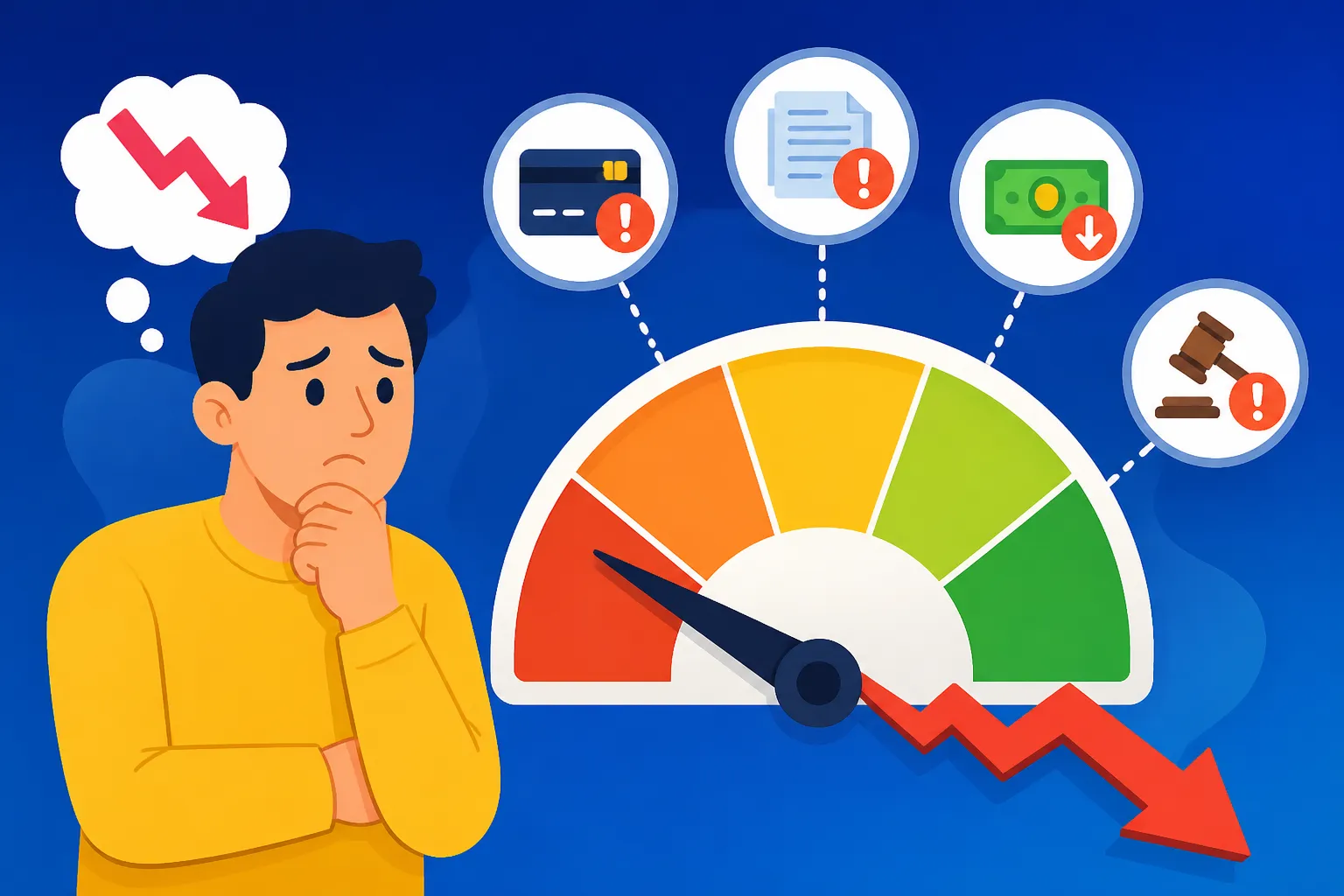
Now let's get down to the most frequent culprits behind a sudden dip in your credit score. These are the situations that most often send that number tumbling, and understanding them is the first step to preventing them or fixing them.
Late or Missed Payments
This is, without a doubt, one of the most damaging things you can do to your credit score. Payment history is the most heavily weighted factor, so when a lender reports that you've missed a payment or paid it more than 30 days late, it sends a huge red flag. Lenders see this and immediately think you might be a higher risk.
The impact isn't just a slap on the wrist; a single 30-day late payment can cause your score to drop by dozens, even over a hundred points, especially if you had an excellent score to begin with. The later the payment (60, 90, 120+ days), the worse the damage. These negative marks can stay on your report for up to seven years. While the impact lessens over time, they still hurt. If you find yourself in a bind, try to make at least the minimum payment before it's 30 days past due. Setting up automatic payments is a great way to prevent this common pitfall. Our article on How Long Does a Late Payment Stay on Your Credit Report? offers more details on this.
High Credit Utilization
Remember we talked about credit utilization being the second most important factor? If you suddenly start using a much larger percentage of your available credit, your score will likely drop. This is often called "maxing out" your credit cards, even if it's just one. Lenders see high utilization as a sign that you might be financially overextended or relying too heavily on credit.
For example, if you have a total credit limit of $10,000 across all your cards and you typically use $1,000 ($10% utilization), your score is probably happy. But if you make a big purchase, like new appliances, and suddenly your balance jumps to $5,000 ($50% utilization), your score could easily drop significantly. Even if you pay off that $5,000 in full before the due date, if your credit card issuer reports the high balance to the bureaus before you pay it off, your score will still take a hit that month. This is why it's often advised to pay down balances before your statement closing date. Learn more about managing this factor in How Much of Your Credit Limit Should You Use?.
New Credit Applications (Hard Inquiries)
Every time you apply for a new line of credit – whether it's a credit card, a personal loan, an auto loan, or a mortgage – the lender typically performs a "hard inquiry" on your credit report. This allows them to assess your creditworthiness. A hard inquiry usually shaves a few points (around 5-10) off your score and stays on your report for two years, though its impact diminishes over time.
A single hard inquiry isn't usually a big deal. However, if you apply for multiple credit accounts in a short period, it can signal to lenders that you're in financial distress or are taking on too much new debt too quickly. This can lead to a more noticeable drop. There's an exception for "rate shopping" for mortgages or auto loans: multiple inquiries for the same type of loan within a specific window (usually 14-45 days, depending on the scoring model) are often treated as a single inquiry, minimizing the impact. But for credit cards, each application typically counts as a separate hard inquiry. Our guide on How to Remove Hard Inquiries From Your Credit Report offers solutions if you have too many.
Closing Credit Accounts
This might seem counterintuitive. You're trying to be responsible, so you close a credit card you don't use anymore. How could that hurt? Well, closing an account can impact two key areas:
- Credit Utilization: If you close an account, you're reducing your total available credit. If your balances on other cards remain the same, your credit utilization ratio will automatically increase, potentially causing a score drop. For example, if you had two cards with $5,000 limits each (total available credit $10,000) and $1,000 balance on one ($10% utilization), closing the unused card would leave you with $5,000 total available credit and still $1,000 balance ($20% utilization).
- Length of Credit History: The credit scoring models like to see a long history of responsible credit use. When you close an older account, it might eventually fall off your report, shortening the average age of your accounts and potentially hurting your score. It’s often better to keep older cards open, even if you only use them occasionally for small purchases that you pay off immediately.
Collection Accounts or Charge-Offs
When an account becomes severely delinquent – typically 180 days past due – the original creditor might "charge it off." This means they've given up trying to collect the debt themselves and consider it a loss. The charged-off account will appear on your credit report and cause significant damage. Often, these charged-off debts are then sold to a third-party collection agency, which then creates a new "collection account" entry on your credit report.
Both charge-offs and collection accounts are major negative marks that can devastate your credit score. They show lenders that you've failed to repay a debt, which is a big red flag. These items can remain on your credit report for up to seven years from the date of the original delinquency. Dealing with collections can be tricky, so it's worth reading our guide on How to Remove Collections From Your Credit Report.
Bankruptcy, Foreclosure, or Repossession
These are some of the most severe negative items that can appear on a credit report, and they indicate a significant financial hardship.
- Bankruptcy: Depending on the type (Chapter 7 or Chapter 13), a bankruptcy can stay on your credit report for 7 to 10 years. It signals to lenders that you were unable to meet your financial obligations and had to seek legal protection from creditors. This will cause a massive drop in your credit score, often by hundreds of points, and rebuilding credit after one can be a long road. Learn more in How to Fix Your Credit After Bankruptcy.
- Foreclosure: If you default on your mortgage and your home is seized and sold by the lender, a foreclosure will appear on your credit report for seven years. This is a clear indication that a major loan was not repaid as agreed, significantly impacting your score.
- Repossession: Similar to a foreclosure but for secured debts like car loans. If your car is repossessed because you stopped making payments, it will be reported to the credit bureaus and remain on your report for seven years, leading to a substantial score drop.
These events are devastating, but they are not permanent. With consistent effort, time, and strategic credit building, it is possible to recover.
Identity Theft and Fraud
Perhaps one of the most frustrating reasons for a credit score drop is when it's not even your fault. Identity theft and fraudulent activity can wreak havoc on your credit. If a thief opens new accounts in your name, makes unauthorized purchases, or fails to pay bills, these negative items will appear on your credit report as if they were yours.
You might see new hard inquiries for credit applications you didn't make, new collection accounts for debts you never incurred, or late payments on accounts you didn't even know existed. This can cause your score to plummet without any action on your part. This is why regularly checking your credit reports and enrolling in credit monitoring services is so important – they can alert you to suspicious activity. If you suspect identity theft, act quickly to protect your financial future. We detail what to do if you're a victim in What to Do If You're a Victim of Identity Theft.
Less Obvious Causes for Credit Score Declines
Sometimes, the reason for a score drop isn't immediately apparent. These less common, but equally impactful, factors can catch you off guard if you're not aware of them.
Errors on Your Credit Report
This is a big one that many people overlook. Credit bureaus (Experian, Equifax, and TransUnion) process millions of pieces of data every day, and mistakes happen. These errors could be anything from a misreported late payment, an account that isn't yours, an incorrect balance, or even a completely fabricated account due to identity theft.
An error, like a collection account that you already paid off but is still showing as open, or a late payment that never actually happened, can suppress your score significantly. It's crucial to regularly review your credit reports from all three bureaus to spot and dispute any inaccuracies. You're entitled to a free copy of your credit report from each bureau once a year via AnnualCreditReport.com. Finding and correcting these errors can often lead to a swift recovery in your score. Our guide on How to Dispute Credit Report Errors Step-by-Step provides a detailed walkthrough.
Becoming an Authorized User on a Risky Account
Being an authorized user on someone else's credit card can be a fantastic way to build credit, especially for young people or those with thin credit files. You get to benefit from their good payment history and long credit age without having to apply for credit yourself. However, it's a double-edged sword.
If the primary account holder starts missing payments, maxing out the card, or closes the account, those negative actions will also appear on your credit report and can cause your score to drop. You have no control over their spending habits, but their financial behavior can directly impact your creditworthiness. Before agreeing to be an authorized user, make sure you trust the primary account holder implicitly and they have an excellent track record of managing credit responsibly. Conversely, if you're the primary holder and you add someone to an account, make sure they understand the responsibilities involved.
Co-signing for a Loan
Co-signing a loan for a friend or family member seems like a kind gesture, but it comes with significant risks to your credit. When you co-sign, you're essentially telling the lender that you're equally responsible for the debt. If the primary borrower fails to make payments, those missed payments will be reported on both your credit report and theirs.
Just like authorized user accounts, you have no direct control over the primary borrower's payment behavior. If they default, it will not only hurt your credit score but could also obligate you to repay the entire debt. Many people find out about a co-signed loan issue only when their credit score drops unexpectedly. It's a serious commitment that should be approached with extreme caution.
Reduced Credit Limits
Sometimes, a credit card issuer might unilaterally decide to reduce your credit limit. This can happen for several reasons: perhaps they've seen some worrying trends in the economy, or maybe they perceive you as a higher risk based on factors they observe (even if you've been paying on time). Sometimes, it happens to dormant accounts where there hasn't been much activity.
Regardless of the reason, a reduced credit limit can immediately impact your credit utilization. If your balance remains the same but your available credit decreases, your utilization ratio goes up, and your score can drop. For instance, if you had a $5,000 limit with a $1,000 balance (20% utilization), and your limit is suddenly cut to $2,000, your utilization instantly jumps to 50%, which is likely to cause a significant score decrease.
How to Investigate a Credit Score Drop
The moment you see that disappointing score, your next step should be investigation. Don't panic; just gather the facts. Pinpointing the exact reason for the drop is the most crucial step toward fixing it.
Checking Your Credit Reports
This is your first and most important line of defense. Remember, your credit score is simply a reflection of the information contained in your credit reports. So, if your score dropped, something changed on one or more of your reports. You need to pull your reports from all three major credit bureaus: Equifax, Experian, and TransUnion. The official source for your free annual reports is AnnualCreditReport.com.
Once you have your reports, examine them meticulously for any changes or inaccuracies. Look for:
- New accounts: Did you open any new credit lines? If not, could it be identity theft?
- Recent hard inquiries: Did you apply for new credit? If you see inquiries you don't recognize, they might be fraudulent.
- Late payments: Are there any new 30-, 60-, or 90-day late payment notations you weren't aware of?
- Increased balances: Check your credit card balances. Have they gone up significantly, especially compared to your credit limits?
- Collection accounts or charge-offs: Are there any new negative marks from debt collectors or original creditors?
- Closed accounts: Did any of your credit accounts get closed, either by you or by the lender?
- Reduced credit limits: Did a lender reduce your credit limit without your knowledge?
Compare the current reports to previous ones if you have them, or simply review each line item carefully. Our guide on How to Read Your Credit Report 2026 Guide can help you navigate this process.
Reviewing Credit Monitoring Alerts
If you're already subscribed to a credit monitoring service, this step becomes much easier. Services like Credit Karma, myFICO, or even those offered by your bank or credit card company often provide alerts when significant changes occur on your credit report. These alerts can tell you immediately if a new account was opened, a hard inquiry was made, or a late payment was reported.
These services don't always give you a full credit report, but they can quickly point you to the specific event that triggered your score drop. For example, if you receive an alert about a new hard inquiry you didn't authorize, you know exactly where to start your investigation for potential fraud. If you get an alert about high credit utilization, you know to focus on your card balances. Many of these services, like the one offered by Experian, can provide you with daily score updates and alerts, making it easier to catch issues quickly.
Steps to Recover and Rebuild Your Credit Score
Seeing your score drop is tough, but it's not the end of the world. With a clear understanding of why it happened, you can put a solid plan in place to bounce back and even strengthen your credit for the long haul. Remember, consistency and patience are your best friends here.
Addressing the Root Cause
The first and most important step to recovery is to directly address whatever caused the drop.
- If it was a late payment: Make the payment immediately. If it was a first-time oversight and you have a good payment history, consider writing a goodwill letter to the creditor asking them to remove the late payment from your report. While they aren't obligated to, some might agree, especially if you're a long-standing customer.
- If it was high credit utilization: Focus on paying down your credit card balances as quickly as possible. Prioritize the cards with the highest utilization. If you can, aim to pay them off before their statement closing dates. Even getting your utilization below 30% can make a significant difference. You might also consider asking for a credit limit increase on an existing card (but only if you won't be tempted to use the extra credit) or opening a new card (only if you can qualify and manage it responsibly) to increase your total available credit and lower your utilization ratio.
- If it was new hard inquiries: There's not much you can do about hard inquiries once they're legitimately on your report, other than wait for their impact to diminish over time. The key here is to avoid applying for new credit unnecessarily. If an inquiry is fraudulent, you should dispute it immediately as part of your identity theft recovery.
- If it was a closed account or reduced limit: You can't undo a closed account or a reduced limit. Your best strategy is to focus on maintaining low utilization on your remaining accounts and ensure all payments are on time. If a credit limit was reduced, contact the creditor to see if there's any way to restore it, but don't count on it.
- If it was a collection or charge-off: This requires a more direct approach. You might consider trying to negotiate a "pay for delete" with the collection agency, where they agree to remove the item from your report once you pay it. Alternatively, debt validation might be an option if you suspect the debt isn't legitimate. Remember, a collection agency must prove the debt is yours. Our guide on Pay for Delete: Does It Really Work? can shed more light on this strategy.
- If it was identity theft or fraud: This is an urgent situation. You must report the theft to the Federal Trade Commission (FTC) and the three credit bureaus immediately. Place a fraud alert or credit freeze on your reports. Then, dispute any fraudulent accounts or charges directly with the creditors and the credit bureaus. This process can be lengthy, but it’s essential. You can learn how to place a credit freeze on all three bureaus by reading How to Freeze Your Credit All 3 Bureaus.
- If it was an error: Dispute the error directly with the credit bureau (Equifax, Experian, or TransUnion) that is reporting it, and also with the creditor if applicable. Provide any documentation you have to support your claim. Correcting errors can often improve your score quickly.
Strategic Credit Building Actions
Beyond addressing the immediate cause, there are broader actions you can take to rebuild and strengthen your credit over time.
- Consistent On-Time Payments: This is foundational. Set up automatic payments for all your bills, not just credit cards, to ensure you never miss a due date.
- Keep Credit Utilization Low: Continue to pay down balances and keep them below 30%, ideally even lower (1-10%) for optimal scoring. Make multiple payments throughout the month if necessary to keep balances low on your statements.
- Consider Credit-Building Tools: If your credit has been severely damaged, you might need a helping hand.
- Secured Credit Cards: These require a security deposit, which often acts as your credit limit. They report to the credit bureaus just like regular credit cards, allowing you to build positive payment history. Many issuers, like Capital One or Discover, offer great secured card options. Find out more in Secured Credit Cards: How They Build Credit.
- Credit Builder Loans: Offered by some credit unions and online lenders, a credit builder loan works in reverse. You make payments into a locked savings account, and once the loan is paid off, you receive the money. The payments are reported to the credit bureaus, helping you build payment history. Companies like Credit Strong specialize in these. It's a structured way to prove you can handle installment debt responsibly.
- Authorized User Status: If you have a trusted family member with excellent credit, asking to be added as an authorized user to one of their long-standing, well-managed credit cards can give your score a boost by inheriting their positive history.
- Rent and Utility Reporting: Services like Experian Boost or similar third-party rent reporting services can allow your on-time rent and utility payments to be included in your credit report, which can add positive data.
- Maintain a Good Credit Mix (Naturally): As your score recovers, you might naturally acquire different types of credit (e.g., a small personal loan, then eventually a car loan). Don't open accounts just for the sake of mix, but allow it to evolve as your financial needs change and your score improves.
Here's a quick comparison of some credit-building tools:
| Feature | Secured Credit Card | Credit Builder Loan | Authorized User Status | Rent Reporting Services |
|---|---|---|---|---|
| Initial Requirement | Security Deposit (e.g., $200-$500) | Regular payments to a savings account | Primary cardholder with good credit | Proof of on-time rent/utility payments |
| Builds What? | Revolving credit history, payment history | Installment credit history, payment history | Inherits primary user's revolving history & age | Payment history for rent/utilities (may vary by bureau) |
| Cost | Annual fee possible, interest on balances | Interest on loan (you get funds later), fees | Usually free, but primary user's actions affect you | Monthly fees often apply |
| Time to See Impact | 1-3 months with responsible use | 6-12 months for full loan cycle | Immediate, if primary user's history is good | 1-3 months for reporting to appear |
| Risk | Can hurt score if misused (late payments) | Minimal if you make payments, but still a loan | High risk if primary user mismanages credit | Low risk if payments are truly on-time |
| Control Over Account | Full control | Full control over your payments | No control over primary account's usage/payments | Full control over your payments |
Patience and Persistence
Rebuilding your credit score after a drop takes time. There's no magic bullet or overnight fix (and beware of anyone promising one – they're likely a scam). Negative items, especially severe ones like bankruptcies or collections, fade in impact as they age, but they don't disappear quickly.
Focus on establishing consistent positive financial habits: paying all your bills on time, keeping credit card balances low, and avoiding unnecessary new credit applications. Regularly check your credit reports to monitor your progress and ensure no new negative items appear. Over time, as positive information accumulates, your score will steadily climb back up. Many people find it helpful to set small, achievable goals, like reducing one card's balance by $100 this month, rather than focusing on the daunting task of raising their score by 100 points overnight. The journey to a better credit score is a marathon, not a sprint. You can read more about how long the overall process can take in our guide on How Long Does Credit Repair Take?.
Disclaimer
The information provided in this article is for educational and informational purposes only and does not constitute financial or legal advice. Credit scores and reporting are complex, and individual situations may vary. Always consult with a qualified financial advisor or credit counselor for personalized advice regarding your specific financial circumstances.